


Chess variants
What Is Freestyle Chess?
Chess960 and Fischer Random explained: the rules, the 960 start positions, castling, the history and where to play
Freestyle chess is chess with one change: the pieces behind the pawns start in a shuffled order, so a game can begin from any of 960 positions. It is the same game as Chess960 and Fischer Random, which Bobby Fischer presented in 1996. The pieces move as usual, castling ends on the usual squares, and opening moves learned by heart are no help.
What is freestyle chess?
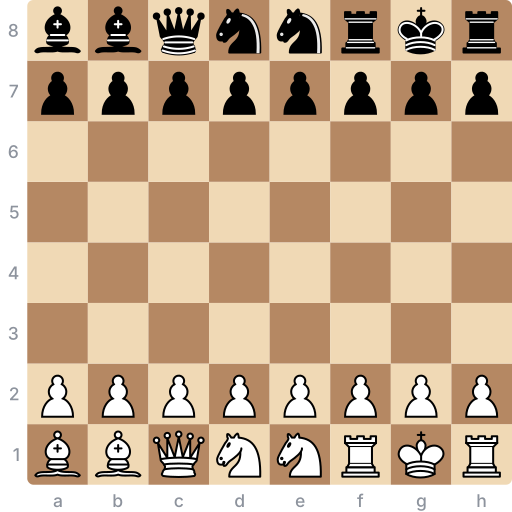
Freestyle chess uses the normal board, the normal pieces and the normal moves. Only the start is different. Before the game, the eight pieces behind each side's pawns are put on the back rank in a random order, and Black's pieces are set up as a mirror image of White's. The pawns stay on their usual squares. The shuffle has two limits: the two bishops must stand on squares of opposite colours, and the king must stand somewhere between the two rooks, so that castling is still possible.
Those two limits leave exactly 960 start positions, and the normal chess setup is one of them. Because a game can begin from any of the 960, nobody can arrive with prepared opening moves. Both players have to think from the first move, which is what Bobby Fischer wanted when he presented the game in 1996. If you are new to chess itself, our guide what is chess covers the normal game first.
- Also called
- Chess960, Fischer Random Chess, Fischerandom
- Start positions
- 960, numbered 0 to 959; normal chess is number 518
- Invented by
- Bobby Fischer, presented in Buenos Aires on 19 June 1996
- Rules
- FIDE Laws of Chess, Chess960 guidelines (in the Laws since 2008)
- World champion
- Magnus Carlsen, FIDE Freestyle Chess World Championship 2026
- Next championship
- 12 to 14 February 2027, Weissenhaus, Germany
- Play online
- Chess.com and Lichess
Freestyle chess, Chess960 and Fischer Random: one game
The game has three common names, and they mean the same thing. On 7 January 2026 FIDE, the world chess federation, said it in one line: "Freestyle Chess is also known as Chess960 or FIDE Fischer Random Chess."
- 1.Fischer Random is the oldest name. Bobby Fischer called the game Fischerandom, and FIDE used Fischer Random for its world championships of 2019 and 2022.
- 2.Chess960 counts the start positions. Fischer asked mathematicians how many were possible, and the answer, 960, became the name (FIDE history of Chess960). It is the name in the FIDE Laws of Chess and on Chess.com and Lichess.
- 3.Freestyle chess is the newest name. Chess.com says the first event to use it was the Freestyle Chess G.O.A.T. Challenge in February 2024. Jan Henric Buettner, who founded the Freestyle Chess company with Magnus Carlsen, wanted a name for people outside the chess world: "Chess960 sounds like a medicine from the pharmacy!" he told Chess.com.
With capital letters, Freestyle Chess is also the name of that company. It ran the 2025 Freestyle Chess Grand Slam Tour, and after an agreement with FIDE on 7 January 2026 it runs the FIDE Freestyle Chess World Championship together with FIDE.
One older meaning still turns up in searches. Around 2005, "freestyle" chess meant games in which the players could use computers for help. The PAL/CSS Freestyle Tournament of 2005 on the Playchess.com server was won by ZackS, a team of amateurs with three computers, which beat teams that included grandmasters. That format has nothing to do with shuffled pieces.
Freestyle chess rules
The rules are part of the FIDE Laws of Chess, in the Chess960 guidelines. FIDE added Chess960 to an appendix of the Laws in 2008, and in March 2025 it called Chess960 the only chess variant it recognises besides traditional chess. The setup follows five rules:
- 1.White's pawns stand on the second rank and Black's on the seventh, as in normal chess.
- 2.White's other eight pieces go on the first rank in a random order.
- 3.The two bishops stand on squares of opposite colours.
- 4.The king stands somewhere between the two rooks.
- 5.Black's pieces stand opposite White's, so both sides have the same back rank.
The position can be picked "by a computer program or using dice, coin, cards", in the words of the Laws. After the setup, the game is played the same way as normal chess: the pieces move as usual, pawns promote as usual, and checkmate wins. Only castling needs new wording, and it has its own section below. For the normal rules, see chess rules.
At top events the players cannot prepare the opening at home. In the 2025 Grand Slam and at the 2026 FIDE Freestyle Chess World Championship, the position was shown to the players 10 minutes before a game, or 5 minutes before a blitz or Armageddon game. Position 518, the normal setup, was left out of the draw, and no position was used twice in the same event.
The 960 start positions
Why exactly 960? Count the ways to place the pieces within the two limits (House of Staunton sets out the sum). The bishop on the light squares has 4 squares to choose from, and the bishop on the dark squares has 4. The queen then has 6 empty squares. The two knights can take any 2 of the 5 squares left, which gives 10 choices. The last 3 squares must take a rook, the king and a rook, in that order, so there is only 1 way to fill them. 4 × 4 × 6 × 10 × 1 = 960.
Each position has a number from 0 to 959, in a scheme by Reinhard Scharnagl (summary by David A. Wheeler). The normal chess setup is number 518. Tournament reports give the position by its number, and the table lists seven numbers worth knowing.
| No. | White's back rank | Why it is known |
|---|---|---|
| 0 | BBQNNRKR | The first number in the list |
| 198 | QNBRKBNR | The most balanced start by the combined measure of a December 2025 study |
| 279 | NRBKNRQB | The best start for White by engine evaluation in the same study |
| 518 | RNBQKBNR | Normal chess; left out of the draw at the 2025 Grand Slam and the 2026 world championship |
| 534 | RNBKQBNR | Normal chess with the king and queen swapped; round 4 of the Freestyle Open in Karlsruhe, April 2026 |
| 535 | RNBKQNRB | Almost level by engine evaluation in the same study |
| 959 | RKRNNQBB | The last number in the list |
Shuffling does not take away White's first-move advantage. A study published in December 2025 ran the Stockfish engine on all 960 positions and found White better in 956 of them. It rated position 279 the best for White and position 535 almost level.
Position 534 has a story of its own. It looks like the wrong setups seen in films and pictures: the normal position with the king and queen swapped. When it came up in round 4 of the Freestyle Open at the GRENKE Chess Festival in Karlsruhe in April 2026, Peter Leko said: "You cannot do this to chess." A 2016 Chess.com blog post recommends 534 as an easy first step into Chess960 for the same reason: almost every piece is where you expect it.
How castling works in Chess960
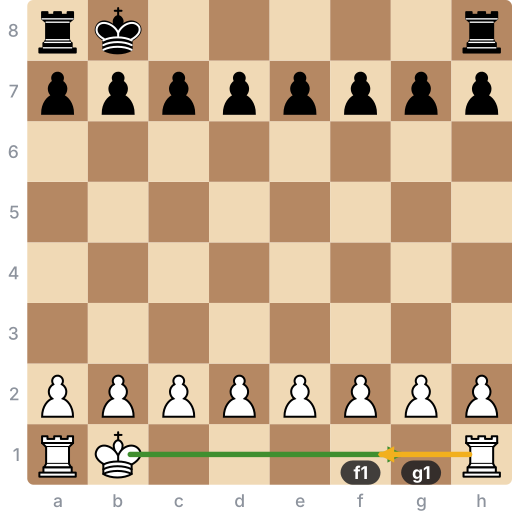
Castling is the rule people ask about most, because the king and the rooks can start almost anywhere. The key is the end squares: after castling, the king and the rook stand exactly where they would after castling in normal chess. Castling on the g-side, written O-O, puts the king on g1 and the rook on f1. Castling on the c-side, written O-O-O, puts the king on c1 and the rook on d1. For Black the squares are g8 and f8, or c8 and d8. The Laws call these g-side and c-side castling; in normal chess they are kingside and queenside castling.
The usual conditions still apply:
- 1.Neither the king nor that rook has moved in the game.
- 2.All squares between the king and its end square, and between the rook and its end square, are empty, apart from the king and that rook.
- 3.The king is not in check, does not cross a square the opponent attacks, and does not end in check.
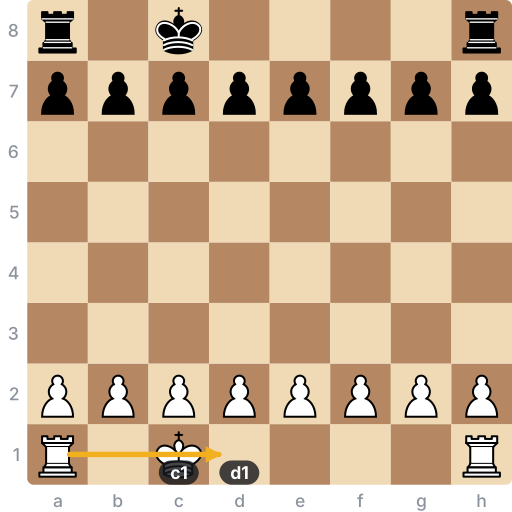
Because the start squares change, castling can look strange. The king can travel five squares, as on the first board. It can stay where it is: if it already stands on c1, castling on the c-side moves only the rook, as on the second board. The rook can stay put too, if it already stands on f1 or d1, and sometimes the two pieces simply swap squares. The Laws list all four forms: double-move castling, transposition castling, king-move-only castling and rook-move-only castling.
On a screen, castling can look like an ordinary king move, for example when the king needs to move only one square. So the apps use a different input. On Chess.com, click the king first and then the rook. On Lichess, the only way to castle is to move the king onto its own rook. The normal rule, with a position to try, is in castling in chess.
Freestyle chess vs normal chess
Freestyle chess changes the start and the wording of one rule. Everything else is the chess you already know.
| Topic | Normal chess | Freestyle chess |
|---|---|---|
| Start position | The same in every game | One of 960, picked at random before the game |
| Pawns | Second and seventh ranks | The same |
| How the pieces move | Standard | The same |
| Check, checkmate, draws, promotion | Standard | The same |
| Castling | King two squares, rook to the other side | King and rook end on the normal castling squares |
| Opening theory | Named openings, studied and memorised | None to memorise; the start changes every game |
| World title | FIDE World Chess Championship | FIDE Freestyle Chess World Championship |
Because the moves are the same, any chess player can start at once. The difference is the opening. In normal chess, strong players know the named openings to great depth; in freestyle chess that knowledge does not carry over, and every plan has to come from the position on the board. That is why our guide to games like chess recommends Chess960 to players who like chess but not the memorising. What does carry over are the general principles: take the centre, develop the pieces and keep the king safe. Our opening principles guide explains them.
Who plays freestyle chess, and why
Bobby Fischer's reason was the opening. He wanted chess that is "not degenerated down to memorization and prearrangement like it is today", as Chess.com quotes him.
Magnus Carlsen, who co-founded the Freestyle Chess company, backs the format for long games in particular. During the G.O.A.T. Challenge, on 9 February 2024, he said: "I'm not saying [Chess960] is better than normal chess, but I think it's more suited to a classical time control."
Levon Aronian, quoted on the Lichess Chess960 page, makes the case for everyday players: "Chess960 is healthy and good for your chess." His point is that when you stop steering towards positions you already know, your chess vision improves.
Top players play it. The 2024 G.O.A.T. Challenge had eight of the world's top 25 at the time, among them Carlsen, Fabiano Caruana, Ding Liren, D Gukesh and Vincent Keymer. Chess.com has held a Chess960 Championship since 2018: Maxime Vachier-Lagrave won the first with 8.5/9, and Vladimir Fedoseev won in 2024, beating Denis Lazavik 3.5-1.5. In January 2025 it started Freestyle Friday, a weekly 11-round event for titled players at 3 minutes plus 1 second a move.
Many more play it online. Lichess, which keeps a separate Chess960 rating, counted 10,740 Chess960 players in the week its page showed on 25 September 2026. Its open database holds 28,413,320 rated Chess960 games played up to the end of May 2026, 381,900 of them in May alone.
Who invented freestyle chess?
Bobby Fischer did, with help. After his 1992 match against Boris Spassky he moved to Budapest, and there he worked out the rules with Susan Polgar, at times joined by Pal Benko, according to FIDE's history of Chess960. They settled three points: the pieces stand symmetrically, the bishops start on opposite colours, and the king starts between the rooks so that castling stays in the game. Fischer asked mathematicians how many positions that allowed, and the answer was 960. He presented Fischer Random Chess in Buenos Aires on 19 June 1996.
The idea of a shuffled start is much older. FIDE traces it to a 1792 book by the Dutch chess enthusiast Philip Julius van Zuylen van Nijevelt and to games played in Mannheim in 1842. David Bronstein promoted a version in the late 1940s, and Pal Benko in the 1970s, in which the players placed their own pieces one at a time. A first international Fischer Random tournament was played in the spring of 1996 in Kanjiza; ChessBase records that the 17-year-old Peter Leko won it with 9.5/11.
| Year | What happened |
|---|---|
| 1792 | Philip Julius van Zuylen van Nijevelt proposes shuffled start positions in his book La Supériorité aux Échecs |
| 1842 | The earliest recorded shuffle-chess games, Van der Hoeven against Alexandre in Mannheim |
| 1940s | David Bronstein promotes shuffle chess; Pal Benko follows in the 1970s |
| 1996 | Peter Leko wins a first international tournament in Kanjiza in the spring; Fischer presents Fischer Random in Buenos Aires on 19 June |
| 2001 | The Chess Classic Mainz starts its Chess960 title with a match: Leko beats Michael Adams |
| 2008 | FIDE adds Chess960 to an appendix of the Laws of Chess |
| 2018 | Maxime Vachier-Lagrave wins the first Chess.com Chess960 Championship |
| 2019 | Wesley So wins the first FIDE World Fischer Random Chess Championship, 13.5-2.5 against Magnus Carlsen |
| 2022 | Hikaru Nakamura wins the second, beating Ian Nepomniachtchi in an Armageddon game |
| 2024 | The Freestyle Chess G.O.A.T. Challenge at Weissenhaus, the first event under the name freestyle chess; Carlsen beats Fabiano Caruana in the final |
| 2025 | The Freestyle Chess Grand Slam Tour; Carlsen is its first overall champion |
| 2026 | FIDE and Freestyle Chess sign an agreement on 7 January; Carlsen wins the first FIDE Freestyle Chess World Championship, 2.5-1.5 against Caruana |
| 2027 | The women's championship from 5 to 7 February and the open championship from 12 to 14 February, both at Weissenhaus |
The first top-level title came from Germany. The Chess Classic Mainz staged a match between Leko and Michael Adams in 2001, later counted as the first Chess960 world championship, and ran the title for the rest of the decade. Four grandmasters won it: Leko, Peter Svidler, Levon Aronian and Hikaru Nakamura. Alexandra Kosteniuk won the women's matches of 2006 and 2008.
FIDE held its own World Fischer Random Chess Championship in 2019, when Wesley So beat Carlsen 13.5-2.5 in the final, and in 2022, when Nakamura won. Then the new name took over. Buettner staged the Freestyle Chess G.O.A.T. Challenge at Weissenhaus in Germany from 9 to 16 February 2024, and Carlsen beat Caruana in the final. In March 2024 Carlsen and Buettner announced the Grand Slam Tour, which Carlsen won overall in 2025. In 2026 FIDE and the Freestyle Chess company started the FIDE Freestyle Chess World Championship, and Carlsen won the first edition at Weissenhaus in February 2026, beating Caruana 2.5-1.5 in the final.
The next championships are at Weissenhaus in February 2027: the women's event from 5 to 7 February and the open event from 12 to 14 February. The players, the qualification paths and the 2026 results are on our Freestyle Chess World Championship page, and other top tournaments are on the events page.
Where to play freestyle chess
Online, Chess.com and Lichess both offer Chess960. Over the board, any normal set will do.
- 1.Chess.com website: open Play, choose 4 Player & Variants, pick Chess960, choose a time control and an opponent, and press Play (Chess.com help).
- 2.Chess.com app, on Android and iPhone: go to Home, then Play, then Custom; tap Standard next to Type, choose Chess960, and press Play (Chess.com help).
- 3.Lichess: free and open source (about Lichess). Chess960 is one of its variants, with its own rating.
- 4.Over the board: the Laws allow a computer program, dice, a coin or cards to pick the position. Let any Chess960 generator pick a number from 0 to 959, set up White's back rank as the generator shows, and mirror it for Black.
Zapp Chess does not offer Chess960. It skips the opening another way: every game starts from a curated middlegame position with the pieces already developed, and the first player to go two points of material ahead or give checkmate wins. A game takes a few minutes. Install the free app for Android or iPhone to play.
Freestyle chess FAQ
What is freestyle chess?
Freestyle chess is chess in which the pieces behind the pawns start in a random order, with the bishops on opposite colours and the king between the rooks. Black mirrors White. That gives 960 possible start positions. All other rules stay the same.
Is freestyle chess the same as Chess960?
Yes. Freestyle chess, Chess960 and Fischer Random are three names for one game. FIDE said so on 7 January 2026: "Freestyle Chess is also known as Chess960 or FIDE Fischer Random Chess." Freestyle Chess is also the name of a company that runs top events.
Why is it called Chess960?
Because there are exactly 960 legal start positions. Each bishop has 4 squares, the queen then has 6, the two knights have 10 ways to share what is left, and the rooks and king fill the last three squares in one way: 4 × 4 × 6 × 10 = 960.
Who invented freestyle chess?
Bobby Fischer. He worked out the rules in Budapest with Susan Polgar and presented Fischer Random Chess in Buenos Aires on 19 June 1996. Shuffled starts are older: FIDE traces the idea to a book of 1792. The name freestyle chess dates from 2024.
How does castling work in Chess960?
The king and rook end on the normal castling squares: king on g1 and rook on f1, or king on c1 and rook on d1 (g8 and f8, or c8 and d8, for Black). Neither piece may have moved, the squares between must be empty, and the king may not castle out of, through or into check.
How do you castle in Chess960 on Chess.com and Lichess?
Move the king onto its own rook. The Chess.com help centre says to click the king first and then the rook, especially when the two stand close together. On Lichess, moving the king onto the rook is the only way to castle.
Is the normal chess setup one of the 960 positions?
Yes. The standard setup is position 518 in the numbering from 0 to 959. The 2025 Freestyle Chess Grand Slam and the 2026 FIDE Freestyle Chess World Championship left it out of the draw, and no position was used twice in one event.
Are all Chess960 start positions fair?
Not quite. A December 2025 study ran the Stockfish engine on all 960 positions and found White better in 956 of them, as White is in normal chess. The study rated position 279 the best for White and position 535 almost level.
How do you play Chess960 on Chess.com?
On the website, open Play, choose 4 Player & Variants, then Chess960, pick a time control and press Play. In the app for Android and iPhone, go to Play, then Custom, tap Standard next to Type, choose Chess960 and press Play.
Who is the freestyle chess world champion?
Magnus Carlsen. He won the first FIDE Freestyle Chess World Championship at Weissenhaus, Germany, in February 2026, beating Fabiano Caruana 2.5-1.5 in the final. The next edition runs from 12 to 14 February 2027. The earlier FIDE Fischer Random titles went to Wesley So in 2019 and Hikaru Nakamura in 2022.
What is the difference between freestyle chess and normal chess?
Only the start. In freestyle chess the pieces behind the pawns are shuffled into one of 960 positions, so opening moves learned by heart do not help. The pieces move the same way, castling ends on the same squares, and every other rule is the same.
Is freestyle chess harder than normal chess?
It is no harder to learn, because the moves are the same. It is harder to prepare for: nobody can memorise openings for 960 starts, so each player must find a plan from the first move. At top events the players see the position only 10 minutes before the game.
Facts on this page were checked on 25 September 2026. The rules are from the FIDE Laws of Chess (Chess960 guidelines, in the edition in force since 1 January 2023); the history is from FIDE's history of Chess960 and ChessBase; the results are from FIDE and Chess.com; the app steps are from the Chess.com help centre and Lichess. Position numbers follow Reinhard Scharnagl's scheme. The Lichess player count is the weekly figure its page showed on 25 September 2026; the page does not give the dates of the week. Sources differ on two points. FIDE names the place of the first 1996 tournament as Kaniza, Yugoslavia, and ChessBase as Kanjiza, Serbia; this page uses the ChessBase spelling. FIDE dates the Mainz championships 2001 to 2009, while ChessBase says the last edition was in 2010, when Nakamura beat Aronian.
