


Chess openings
Best Chess Openings for Beginners
Choosing your first opening
There are hundreds of named openings, and you need exactly two — one for White, one answer to 1.e4. Here's how to find yours by playing twenty games, not by reading twenty guides.
- What you need
- One opening as White, one reply to 1.e4 as Black
- What decides it
- The kind of middlegame you enjoy — not the opening's name
- Time to decide
- About twenty games
- Study required
- None — the test is played, not read
The two kinds of openings
Every opening you'll ever meet falls into one of two broad kinds, and knowing which kind you're looking at tells you most of what learning it will feel like.
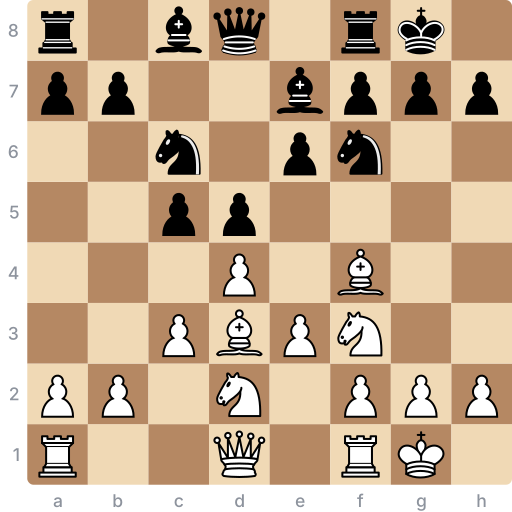
put the same pieces on the same squares nearly every game. The London System is the clearest example: 1.d4, then Bf4, e3, Bd3, Nf3, Nbd2, c3, castle. Same house every game, whatever your opponent builds across the board. What you learn is a shape, so there's very little to remember, and almost nothing your opponent can do to knock you out of it.
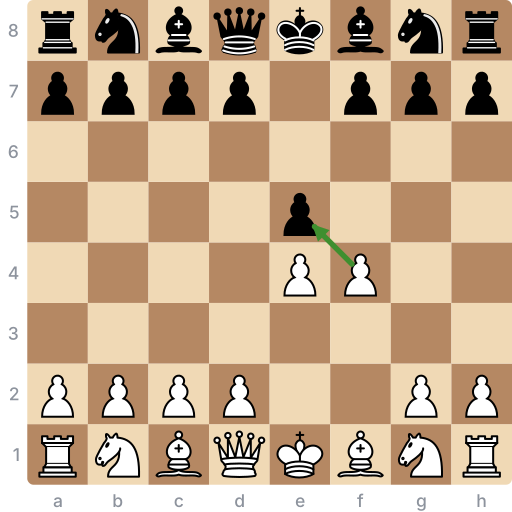
branch. Your correct move depends on what your opponent just played, so what you learn is a tree of replies rather than a single shape. The open Sicilian branches this way, and nearly every does too — offer a pawn, and your opponent's choice of taking it, declining it or hitting back sends the game down genuinely different roads. What you get in exchange for the extra work: sharper positions and earlier chances.
Neither kind is better. They produce different games, and the whole question of choosing an opening comes down to this: which of those games would you rather be playing on move fifteen?
Your first move picks a neighbourhood
As White, your first move already leans one way or the other. 1.e4 leans toward open positions and early tactics — the Italian Game, the Vienna Game and most of the famous attacking openings live there. 1.d4 leans toward closed centres and slower play built on pawn structure — the Queen's Gambit and the London System live there. Here's what those two words, "open" and "closed", actually look like on the board. A red arrow points from an attacker to the piece it threatens — with a red circle around a piece in real danger — and a gold arrow points from a defender to the piece it guards. These are the same colours our move-by-move trainers use.
Italian Game · from 1.e4
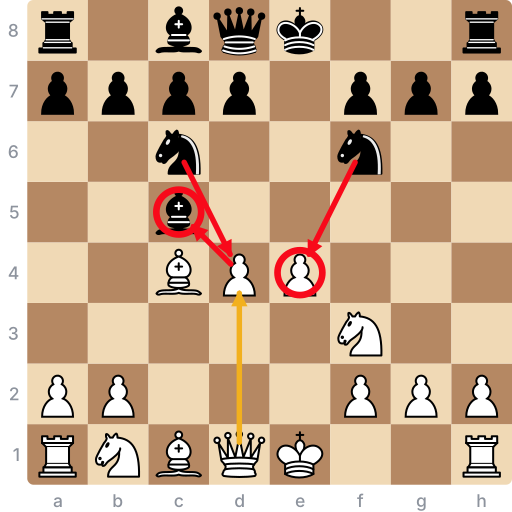
Open position. Six moves in and there are already three attacks on the board — and the circled pieces, the c5 bishop and the e4 pawn, have no defender at all. Someone wins or loses material in the next few moves. That's what "early tactics" means.
Queen's Gambit · from 1.d4
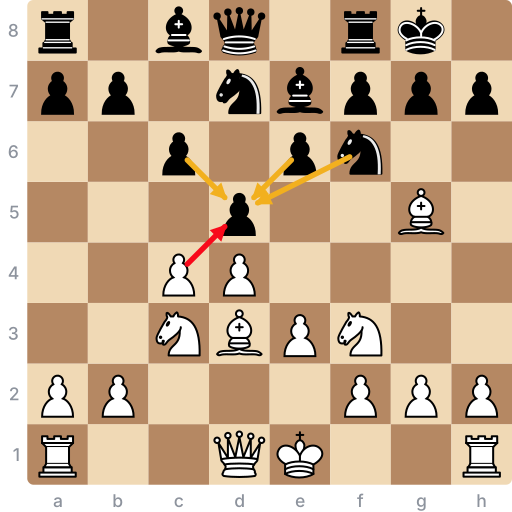
Closed centre. Seven moves in and there is exactly one attack: White's c4 pawn threatens d5. And it goes nowhere, because three defenders all guard d5. Nothing can be won by force, so both sides slowly improve behind the pawn wall. That's what "structure and patience" means.
It's a tendency, not a law — both first moves can produce both kinds of game. But it's real enough that a good first question to ask yourself is simply: which of these two boards would I rather be playing?
After 1.e4. For White the main choices are the Italian Game (3.Bc4), the Ruy Lopez (3.Bb5), the Scotch Game (3.d4), the Vienna Game (2.Nc3) and the King's Gambit (2.f4). For Black the main answers are the Sicilian Defense (1...c5), the French Defense (1...e6), the Caro-Kann Defense (1...c6), the Scandinavian Defense (1...d5), the Pirc Defense (1...d6) and Alekhine's Defense (1...Nf6).
After 1.d4. For White the main systems are the Queen's Gambit (2.c4 against 1...d5), the London System (2.Bf4), the Catalan Opening (c4 with the bishop on g2) and the Trompowsky Attack (2.Bg5 against 1...Nf6). For Black the main answers are the Slav Defense (1...d5 and 2...c6), the King's Indian Defense (...Nf6 and ...g6), the Grünfeld Defense (...Nf6, ...g6 and ...d5), the Nimzo-Indian Defense (...Bb4 against Nc3), the Queen's Indian Defense (...b6), the Bogo-Indian Defense (...Bb4+ against Nf3), the Benoni Defense (...c5 and ...e6 after d5), the Benko Gambit (...c5 and ...b5) and the Dutch Defense (1...f5).
Flank openings. White can also start with the English Opening (1.c4), the Réti Opening (1.Nf3 and 2.c4), the King's Indian Attack (1.Nf3 and 2.g3), Bird's Opening (1.f4), the King's Fianchetto Opening (1.g3), the Nimzowitsch-Larsen Attack (1.b3), the Polish Opening (1.b4) or the Grob Opening (1.g4). Each name above links to a move-by-move trainer.
The twenty-game test
You can't find your taste by reading descriptions of it. You find it by playing both kinds and noticing which one felt like home. The test takes about twenty games, and it works like this.
Games 1–10 · Play five of each kind
Pick one setup opening and one line opening — any pair works, and Part 3 of this series gives you ready candidates. Play five games with each as White. Don't study lines first; play on general sense and let the games be messy.
After game 10 · Ask one question
Not "which scored better" — at this stage, results mostly measure who hung a piece first. Ask instead: in which games did I know what I was trying to do? If you felt at home slowly improving your position, you lean setup. If the slow games bored you and the sharp ones woke you up, you lean lines and tactics.
Games 11–20 · Compare inside the winning kind
Take two or three openings of the kind you preferred and give each five games. This round is about the differences inside a family — the Italian and the Vienna are both open, tactical 1.e4 openings, but they reach for the fight in different ways.
Then · Commit to one
Pick the opening you understood best and play it in every game for a few months. Depth beats breadth here by a wide margin: one opening played fifty times teaches you more than five openings played ten times each.
Don't rush the test. The opening you settle on tends to stay with you for years — players routinely keep their first serious opening for a decade or more, because switching later means rebuilding pattern memory from zero. Twenty exploratory games now is cheap insurance against learning the wrong opening deeply.
Where to find your candidates
You don't need a full menu — you need one reasonable candidate per taste. Part 3 of this series lays out nine, each with its position on a board, what it wants, who it suits, and a move-by-move course to learn it. For the test: the Italian Game or Vienna Game as your line candidate, the London System or Queen's Gambit as your setup candidate — and against 1.e4, the calm Caro-Kann or the direct Scandinavian.
What about gambits?
A offers a pawn in the opening to get something faster in return — usually development and open lines. They're the most tempting openings on any list, because they promise quick wins, and some deliver.
The King's Gambit (1.e4 e5 2.f4) is the classic gambit for White, and the Benko Gambit (1.d4 Nf6 2.c4 c5 3.d5 b5) is the best-known one for Black. The Queen's Gambit is a gambit only by name: after 2...dxc4 White regains the pawn with normal moves.
The honest accounting: a gambit teaches you the value of the initiative, forces you to develop quickly, and punishes slow opponents — all genuinely useful lessons. But it's a line opening of the sharpest kind. If your opponent knows the right answer and you don't, you're simply a pawn down. And a pawn matters more with every hundred points of Elo you gain, because games start reaching endgames.
The practical answer for a beginner: play a gambit as seasoning, not as the whole meal. Use one as your line-opening candidate in the test if sharp play attracts you, and keep solving chess tactics alongside it — a gambit without tactics is just a missing pawn.
Mistakes people make when choosing
- Choosing by fashion. An opening a champion plays is tuned for opponents who never blunder. What it needs to work — precise move orders, deep preparation — is exactly what you don't have yet. Choose for the games you actually play.
- Learning five at once. Every opening you add divides your practice. Five openings at ten games each stay strangers; one at fifty games becomes yours.
- Judging by results too early. Ten games of results at beginner level mostly measure blunders, yours and theirs. Judge by comfort — whether you knew what you were trying to do.
- Switching after every loss. A loss almost never means the opening failed; it usually means a piece hung on move twenty-three. Check where the game was actually lost before blaming move two.
- Picking sharpness you cannot back up. The wildest line is only as good as your tactics. If a daily chess puzzle isn't part of your week yet, lean for now.
Mastering the one you picked
Mastery here is not memorising deeper lines — it's playing the same opening often enough that its positions feel like home. Three habits get you there.
- Play it in every game for a few months. No rotating, no moods. The value of an opening is pattern memory, and pattern memory only comes from repetition.
- Review only the first ten moves. After a loss, check where your development stopped following the plan — the order of jobs from Part 1. Ignore the rest of the game for now.
- Stay until the opening stops surprising you. Switch only when the positions genuinely bore you game after game, or you keep reaching move twelve in trouble and can point to why. Boredom matters — an opening you dislike is an opening you won't practise.
Questions people ask
Should a beginner play 1.e4 or 1.d4?
Either is fine. 1.e4 brings tactics sooner, which teaches faster; 1.d4 brings calmer structures, which forgives more. That's exactly the taste question the twenty-game test answers — so test it rather than taking anyone's word.
How many openings does a beginner need?
Two: one as White and one answer to 1.e4 as Black. A reply to 1.d4 can wait until you actually start meeting 1.d4, which at beginner level takes a while.
What is the easiest opening to learn?
Among setup openings, the London System — the same structure nearly every game. Among Black's answers, the Scandinavian — your first move settles the whole opening.
How do I know if I am a tactical or a positional player?
You don't find out by thinking about it, and you don't need a label. Play five games each way and notice where you were comfortable. The answer also changes as you improve — which is fine, because openings can change with you.
Are gambits good for beginners?
Good as one candidate, risky as a whole repertoire. They teach initiative and fast development, but they need tactical sharpness to back them up, and they give up a real pawn when the attack fizzles.
Do I even need an opening under 1000 Elo?
Guides on how to play chess for beginners stop at the rules — habits are the next step. You need opening habits — a pawn in the centre, pieces developed with a purpose, castle early — more than you need a named opening. A named opening is just the most convenient container for practising those habits.
What if I pick wrong?
Nothing is lost. Development habits, king safety, pawn-structure sense — everything an opening teaches transfers to the next one. The only real cost of switching is pattern memory, which is exactly why the test tries both kinds before you invest.
Part 2 of the best-chess-openings-for-beginners series. Every board position in this article is replayed through a chess engine library at build time, so each position is legal and reachable. The openings named here each have a full move-by-move course of their own.
